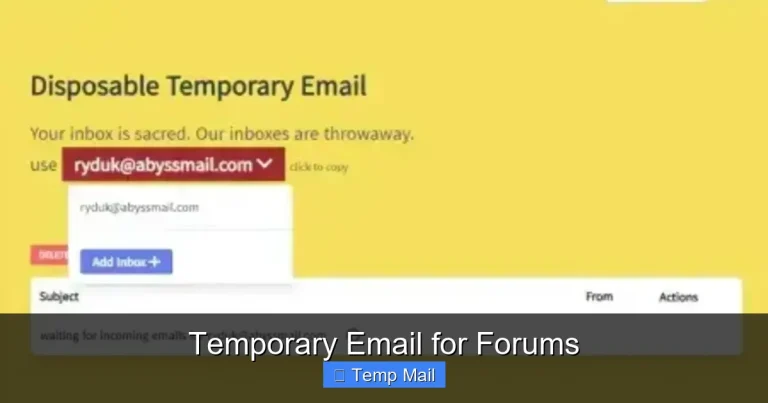

Temp Mail Secure Inbox
A temp mail secure inbox is your digital shield against spam, data harvesting, and inbox clutter. It provides a temporary, anonymous email address that automatically deletes messages after use, ensuring your primary email stays private and secure. These services use strong encryption and no-logs policies to protect your activity, making them ideal for signing up to untrusted websites, downloading files, or verifying accounts without risk. However, they are not suited for sensitive transactions like banking. By choosing a reputable provider with robust security features, you can safely navigate the web while keeping your identity and main inbox completely protected.
Key Takeaways
- Privacy First: A secure temp mail inbox acts as a protective barrier, preventing companies from collecting your primary email address and associated personal data.
- Core Security Features: Look for end-to-end encryption, strict no-logs policies, and automatic message deletion timers as non-negotiable for true security.
- Ideal for Low-Stakes Verification: Perfect for forum sign-ups, accessing gated content, or downloading software where you need an email but don’t trust the recipient.
- Critical Limitations: Never use a disposable address for banking, primary account recovery, official government communications, or any service requiring long-term access.
- Auto-Deletion is Key: The entire security model relies on emails being automatically purged after a short period (e.g., 24 hours to 1 week), eliminating data residue.
- Provider Trust is Paramount: Your security depends on the provider’s integrity; research their privacy policy, jurisdiction, and reputation before use.
- Anonymity vs. Security: While many services offer anonymity (no sign-up), true security requires technical safeguards like encryption, which not all anonymous services provide.
📑 Table of Contents
- Understanding the Temp Mail Secure Inbox: Your Digital Disguise
- The Inner Workings: How a Secure Temp Mail Inbox Functions
- Core Security Features That Separate the Good from the Bad
- Perfect Use Cases: When to Reach for Your Disposable Shield
- What Temp Mail Can’t Do: Critical Limitations and Pitfalls
- Selecting a Trustworthy Temp Mail Service: Your Security Checklist
- Best Practices: Using Your Secure Temp Mail Inbox Like a Pro
- Conclusion: Embracing Impermanence for Lasting Privacy
Understanding the Temp Mail Secure Inbox: Your Digital Disguise
Let’s talk about your email inbox. It’s probably a mess. Promotions you never asked for, newsletters from a website you visited once in 2015, and the ever-present fear that your address is being sold to the highest bidder. What if you could have a secret identity for the web? A digital disguise you slip into for the sketchy parts of the internet, then discard without a trace? That’s the promise of a temp mail secure inbox. It’s not just a random burner email; it’s a carefully designed tool for privacy in an age where every click is tracked.
Think of your primary email address as your home address. You give it to friends, family, and trusted institutions like your bank. You wouldn’t hand it out to every stranger on the street, right? Yet, online, we do exactly that. Every time you sign up for a new app, download a PDF, or comment on a blog, you’re essentially shouting your home address into a crowded room. A temp mail secure inbox gives you a perfectly good, fully functional P.O. box for those interactions. It receives the mail (the verification link, the download link), lets you access it, and then vanishes, taking all that potential spam and data-harvesting risk with it.
But here’s the crucial distinction: not all temporary email services are created equal. The word “secure” is the magic qualifier. A basic temp mail service might generate a random address and show you the inbox on a public page—anyone with the link can see it! That’s not secure; that’s just inconvenient. A secure temp mail inbox adds layers of protection. It ensures that only you can access the messages meant for your temporary address, often through private, session-based links or simple authentication. More importantly, it builds its entire system on the foundation of encryption and strict data deletion policies. This article will dive deep into what makes a temp mail inbox truly secure, how it works behind the scenes, and, most importantly, how you can use it wisely to reclaim your digital privacy without sacrificing convenience.
The Inner Workings: How a Secure Temp Mail Inbox Functions
At first glance, using a temp mail service seems absurdly simple. You click a button, get an address like xyz789@domain.com, and a new inbox loads in your browser. But what happens between that click and your ability to read a verification email? Let’s peel back the layers.
Visual guide about Temp Mail Secure Inbox
Image source: vision-crm.com
The Generation and Assignment Process
When you request a temporary address, the service’s server runs an algorithm to generate a unique, random string for the username (the part before the @). The domain is fixed (e.g., @tempmail.secure). This address is then instantly mapped to a newly created, isolated inbox database on their servers. This mapping is temporary and session-specific. In a secure setup, this inbox is not publicly listed or searchable. The only way to access it is through the unique, unguessable URL or session token provided to you at the moment of creation. It’s like a hotel room: the address exists, but only you have the key (the URL) to get in.
Mail Routing and Storage
When an email is sent to your temporary address, the sending server (like Gmail or Yahoo) looks up the MX records for the temp mail domain. These records point to the temp mail provider’s mail servers. The provider’s server accepts the message, scans it for malware (a basic security step), and stores it in the encrypted inbox database linked to your session. Here’s a key security practice: reputable services do not store emails on their servers long-term. They implement aggressive auto-deletion timers. The clock starts the moment the email is received. After 1 hour, 24 hours, or at most 7 days (depending on the service), the email and its associated inbox metadata are permanently wiped from the system using secure deletion methods. This means even if a hacker breached the server later, there would be nothing to find.
Access and User Interface
You access your inbox via the unique URL given to you. A secure service ensures this URL is long, random, and not predictable. It should also expire after a period of inactivity. When you open the inbox, your browser establishes a secure, encrypted connection (HTTPS/TLS) to the provider’s server. The server decrypts the emails for your session and displays them. Once you close the browser or the session times out, that specific access path is destroyed. You are not creating an account with a password; your “login” is possession of that ephemeral URL. This model maximizes anonymity and minimizes data retention.
Core Security Features That Separate the Good from the Bad
Not all services offering a “temp mail” label provide a secure inbox. Many are simple, open, and insecure. To find a truly secure provider, you must look for these non-negotiable features. Think of this as your security checklist.

Visual guide about Temp Mail Secure Inbox
Image source: darksms.com
End-to-End Encryption (E2EE) and TLS
This is the gold standard. Transport Layer Security (TLS) secures the connection between your browser and the temp mail server. It’s the “S” in HTTPS. It prevents eavesdroppers on your network (like a coffee shop Wi-Fi) from seeing the emails in transit. However, TLS only protects data in motion. End-to-End Encryption (E2EE) is even stronger. With E2EE, the email content is encrypted on the provider’s server using a key that only you possess (often derived from your session). The provider themselves cannot read the content of your emails. They store only gibberish. If the server is compromised, the attacker gets encrypted blobs. While not all temp mail services implement full E2EE due to complexity, the most secure ones do, or at least use robust server-side encryption where keys are securely managed and destroyed with the data.
Strict No-Logs and Minimal Data Policy
A secure provider’s business model should not rely on selling your data. Therefore, they must have a clear, transparent no-logs policy. This means they do not record your IP address, timestamp of use, device information, or the content of your emails beyond the absolute minimum needed to deliver the message (which is then auto-deleted). The policy should state that no personal data is correlated with your temporary session. Read the privacy policy. If it’s vague or says they may collect “analytics data” that could identify you, run. True security means the provider is incapable of knowing who you are or what you did with your temp address.
Aggressive Auto-Deletion Timers
The cornerstone of the temp mail security model is impermanence. A secure inbox must have a short, hard-coded auto-deletion timer. The best services offer options: 1 hour, 24 hours, 1 week. Anything longer than a week defeats the purpose of “temporary” and increases risk. The deletion should be comprehensive: email bodies, attachments, headers, and the inbox record itself. There should be no “archive” or “trash” folder that retains data longer. The system should be designed so that once the timer hits zero, the data is gone forever from their active systems and backups (if they keep them at all, which is questionable for true security).
Secure, Ephemeral Access Links
Your access to the inbox is via a URL. A secure service generates this URL with high entropy (lots of random characters). It should be a one-time use or session-based link. If someone else stumbles upon that URL while your session is active, they could see your mail. Therefore, the link should expire quickly after you close your browser or after a set time of inactivity (e.g., 30 minutes). Never share your inbox URL. A secure provider also ensures the URL is transmitted only over HTTPS and is not logged in your browser history in a way that could be recovered.
Open-Source Code and Independent Audits
This is the highest level of trust. Can you verify the security claims? Services that open-source their client-side code (the browser interface) allow security experts to audit it for backdoors or vulnerabilities. Even better are providers who have undergone independent, third-party security audits. While less common in the temp mail space due to its niche nature, this is a strong indicator of a provider that is serious about security and has nothing to hide. Look for a “Security” or “Transparency” page on their website that details these efforts.
Perfect Use Cases: When to Reach for Your Disposable Shield
Knowing how a secure temp mail inbox works is useless if you don’t know when to use it. Let’s map out the scenarios where this tool is not just helpful, but essential for maintaining your digital hygiene and privacy.

Visual guide about Temp Mail Secure Inbox
Image source: darksms.com
Signing Up for “Sketchy” or Low-Trust Websites
This is the classic use case. You want to read an article on a site that demands an email sign-up. You’ve never heard of the site, the design looks dated, and the privacy policy is a single paragraph. Using your primary email here is a gamble. They might sell your address to spam networks, or worse, suffer a data breach that exposes your email and the password you (hopefully didn’t) reuse. A secure temp mail inbox lets you get the content, verify the account, and then forget about it. The verification email goes to the disposable address, you click the link, and your primary email remains pristine and unassociated with that potentially shady entity.
Downloading Files from Unverified Sources
You found a free design template, a cracked software installer (be careful!), or a useful ebook from a forum. The download link is hidden behind an “enter your email to receive the download link” gate. Again, the source’s reputation is questionable. Using a temp mail address here is smart. You get the download link in the disposable inbox, grab the file, and let the inbox and its contents vanish. This prevents the file-hosting site from adding you to a mailing list or, if they’re malicious, using your email as a vector for phishing later.
Creating Test Accounts for Apps and Services
Are you a developer testing a new app’s sign-up flow? A marketer wanting to test a lead magnet without polluting your company’s CRM? A regular user wanting to try a subscription service’s free trial without the inevitable reminder emails? A secure temp inbox is perfect. You create a throwaway account, do your testing or trial, and abandon it. No cleanup required on your end. The service automatically purges the evidence.
Protecting Your Identity on Public Platforms
You want to post an honest, critical review on a public forum or comment section but fear backlash or being added to a marketer’s list. Using a temp mail address to register for that forum adds a layer of anonymity. It separates your online persona (the reviewer) from your real identity (your primary email). For whistleblowers, activists, or anyone in a precarious situation, this separation can be a vital safety measure, provided the temp mail service itself is secure and does not log IPs.
Bypassing Regional Gating or “Email Wall” Paywalls
Some news websites or research papers allow a limited number of free articles per month, tracked by your email address. Others simply block access entirely unless you provide an email. A disposable email allows you to circumvent these gates ethically (if you abide by the site’s terms) to access information you need for research or casual reading, without creating a permanent marketing profile.
What Temp Mail Can’t Do: Critical Limitations and Pitfalls
Understanding the power of a tool is only half the battle. Understanding its limitations is what prevents disaster. A secure temp mail inbox is a scalpel, not a Swiss Army knife. Using it for the wrong job can leave you cut.
Never for Financial, Legal, or Official Government Communications
This is the cardinal rule. Banks, government agencies (IRS, DMV), courts, and legal firms require a permanent, verifiable, and recoverable email address. They send official notices, statements, and legal documents. If you use a temp mail address that auto-deletes after 24 hours, you will never see your bank statement, your tax audit notice, or your jury duty summons. The consequences can range from financial penalties to legal trouble. These institutions also often have systems that flag or reject known disposable email domains, so the sign-up might fail anyway.
The Two-Factor Authentication (2FA) Trap
Many services now require 2FA, where a code is sent to your email or phone. If you use a temp mail address for an account that later requires 2FA, you are locked out the moment you need that verification code. Your temporary inbox is gone. You cannot recover the account. Therefore, for any account you might need to recover or access long-term (social media, cloud storage), you must use your primary, permanent email. The temp mail is only for the initial, low-value sign-up that doesn’t lead to a valuable account.
Account Recovery and Password Resets Are Impossible
Closely related to 2FA. “Forgot Password?” links go to your email. If that email is gone, so is your ability to reset the password. You have permanently lost access to that account. This is why temp mail should only be used for accounts where you have zero emotional or financial investment—accounts you plan to abandon after the initial purpose is served.
It’s Not Anonymous from a Determined Adversary
While a secure temp mail provider doesn’t log your IP, your internet service provider (ISP) knows you visited the temp mail website. A government agency with a warrant could compel the ISP to produce those logs. Furthermore, if you use the temp mail account to send emails from the disposable address, those emails contain your IP address in the headers (unless you use a VPN or Tor). The recipient can see it. So, the anonymity is primarily from the service provider and from marketers, not from a global surveillance agency. For high-risk anonymity, you need Tor and other operational security (OpSec) measures, not just a temp mail.
Some Services Actively Block Disposable Domains
Many popular platforms (Google, Facebook, Microsoft, major banks) maintain lists of known disposable email domains and will block sign-ups from them outright. You’ll get an error message saying the email is invalid. This is a good thing! It’s a security measure for them, and it saves you from accidentally creating a critical account with a non-recoverable address. However, it means you can’t use a temp mail for everything. You must know which services accept them.
Selecting a Trustworthy Temp Mail Service: Your Security Checklist
With the limitations clear, how do you pick a provider that actually delivers on the “secure” promise? The market is full of fly-by-night sites with flashy ads but terrible privacy practices. Use this checklist to vet any service.
Jurisdiction and Legal Base
Where is the company legally based? This matters because different countries have different data retention and surveillance laws. A provider based in a country with strong privacy laws (like Germany, Switzerland, or Panama) and outside the “Five Eyes” intelligence alliance (US, UK, Canada, Australia, NZ) is generally preferable. They are less likely to be compelled to hand over user data to foreign governments. Check their “About” or “Legal” page for a physical address and company name. If it’s nonexistent or vague, be suspicious.
Transparency of Security Practices
A trustworthy provider will proudly explain their security measures. Look for a dedicated Security or Privacy page. It should explicitly state:
- Encryption used: TLS 1.3+ for connections, AES-256 for stored data (if stored at all).
- Data retention policy: “Emails are automatically deleted after X hours.”
- No-logs policy: “We do not log IP addresses, timestamps, or access patterns.”
- Cookie policy: Do they set tracking cookies? A secure service should use only strictly necessary session cookies.
If this information is buried or absent, assume the worst.
Domain Reputation and History
Is the temp mail domain (the part after @) known for abuse? Some domains get blacklisted by major email providers (Gmail, Outlook) because spammers overuse them. If your verification email from a legitimate service bounces because the temp mail domain is on a blacklist, the service is useless. Do a quick search: “is [domain.com] blacklisted?” Also, check how long the domain has been registered. A brand-new domain is a red flag; established services have been around for years and have built a reputation.
User Experience and Interface
Security shouldn’t mean ugliness. A good secure temp mail service has a clean, fast, and intuitive interface. You should see your inbox list, the email subject, and a preview pane. It should work on mobile browsers. Beware of sites littered with aggressive ads, pop-ups, and misleading “Download” buttons. These are often adware farms that don’t care about your security and may even inject malware. A clean, ad-light (or ad-free) interface is a sign the service might have a sustainable, premium model rather than relying on shady advertising.
Additional Features That Matter
Some valuable extras include:
- Multiple domain options: Ability to choose from several @domains if one gets blocked.
- Custom username generation: Not just random strings, but the ability to pick a readable alias (though random is more secure).
- API access: For developers, a documented API allows integration into workflows.
- Browser extensions: A vetted extension from the official provider can auto-fill temp mail addresses on websites.
- Clear “Delete Now” button: Manually purge your inbox before the timer for extra peace of mind.
Best Practices: Using Your Secure Temp Mail Inbox Like a Pro
You’ve chosen a reputable provider. Now, how do you use it correctly to maximize privacy and minimize risk? Follow these habits.
Treat Each Inbox Like a Single-Use Item
The safest mindset is: one purpose, one address. Use a fresh, new temporary address for each unrelated sign-up. Don’t reuse the same temp address for ten different websites. If one of those sites is compromised or sells your address, all the other sites you used that same address with now have a link to your online activity pattern. By using a unique disposable address for each site, you compartmentalize your digital footprint. If Site A spams your temp address, you just abandon that address. Site B remains unaffected.
Never Use It for Anything You Might Regret
Reiterate the limitations. Do not use it for:
- Primary email for any service you value.
- Password recovery for any important account.
- Financial transactions or statements.
- Job applications or professional communications.
- Communications with government agencies.
- Anything that could have legal ramifications.
Stick to the “low-stakes verification” zone: content gates, free trials for non-essential software, forum registrations for a one-time question.
Combine with a VPN for Maximum Anonymity
While a secure temp mail provider won’t log your IP, your ISP still sees you connecting to their server. If you are concerned about your ISP or network admin seeing your activity, use a reputable Virtual Private Network (VPN) or the Tor browser before accessing your temp mail. This encrypts all traffic from your device to the VPN/exit node, masking your real IP address from the temp mail provider (though they still see the VPN’s IP, which is shared among many users). This two-layer approach (VPN + secure temp mail) significantly raises the bar for anyone trying to trace your online activity back to you.
Clear Your Browser History and Cache
After you’re done with a session, close the browser tab and clear your browsing data for that site, or use private/incognito mode from the start. This removes the unique inbox URL from your history. If someone gains physical access to your computer, they shouldn’t be able to open your browser and find a list of your past disposable inboxes. In incognito mode, the session data is automatically wiped when you close the window, making it the ideal way to access a temp mail inbox.
Have a Permanent Backup for Critical Accounts
This is a mental model: your primary email is your digital identity anchor. Use it only for accounts that are critical to your life: banking, primary cloud storage (iCloud, Google Photos), main social media, healthcare portals, and any service where account recovery is vital. Guard this email address with a strong, unique password and 2FA (using an authenticator app, not SMS). Let the temp mail handle the rest. This clear separation prevents catastrophic lockouts.
Conclusion: Embracing Impermanence for Lasting Privacy
The temp mail secure inbox is more than a convenience tool; it’s a fundamental privacy instrument for the modern web. It embodies a powerful concept: not every interaction needs to be tied to your permanent identity. By leveraging temporary, encrypted, and self-destructing email addresses, you break the cycle of data aggregation that fuels the surveillance economy. You stop the spam at the gate before it ever reaches your primary inbox. You prevent your email address from becoming a commodity sold on data brokers’ lists.
However, this power comes with a responsibility to understand its limits. Using a secure temp mail service for a bank account is like using a life raft to cross a highway—it’s the wrong tool for the job, and you will get hurt. The key is discernment. Use it for the low-value, high-noise sign-ups that clutter our digital lives. Reserve your permanent, secure email for the pillars of your digital identity.
As you navigate the web, adopt the mindset of a privacy-conscious user. Ask yourself: “Does this website truly need my real email?” If the answer is no, reach for your secure temp mail inbox. Choose a provider that proves its security through transparency, encryption, and a clear no-logs policy. Use it in incognito mode, clear your tracks, and treat each address as a single-use token. In doing so, you take an active, effective step toward reclaiming your privacy—one disposable inbox at a time.
Frequently Asked Questions
Is using a temp mail secure inbox truly safe and private?
It can be, but only if you choose a reputable provider with strong security features like encryption, no-logs policies, and auto-deletion. A secure service protects your activity from the provider and from data leaks. However, it does not make you anonymous from your ISP or a government with legal authority, so it should never be used for illegal activities.
Can I use a temp mail for important account recovery or banking?
Absolutely not. Temp mail addresses are temporary by design and emails auto-delete quickly. You will never receive password reset links or bank statements, leading to permanent loss of account access and serious financial or legal problems. Use a permanent, secure email only for critical accounts.
How long do emails stay in a secure temp mail inbox?
It varies by provider, but a hallmark of security is a short, automatic deletion timer. Most secure services delete emails after 1 hour, 24 hours, or at most 7 days. You should never rely on a temp mail address for anything requiring access after that window.
What’s the difference between a secure and a regular temp mail service?
A regular temp mail service might offer a public inbox where anyone with the URL can see your emails, and it likely logs your IP and data. A secure service uses private, session-based access, encrypts data, has a strict no-logs policy, and guarantees automatic, permanent deletion of all emails after a short period.
Are temp mail services legal to use?
Yes, using a disposable email address is perfectly legal. The legality depends on how you use it. Using it to avoid spam or protect privacy on low-stakes websites is fine. Using it to defraud someone, bypass bans maliciously, or conduct illegal business is illegal, regardless of the email address type.
What happens if I need an email from a service after my temp inbox has expired?
There is no recovery. Once the auto-deletion timer expires, the email and the inbox itself are permanently gone. This is why you must never use a temp mail address for any service where future communication is important, expected, or required for account access.