
Temp Mail Otp Receive
Using a temporary email address to receive OTPs (One-Time Passwords) is a smart, simple way to shield your personal inbox from spam, marketing emails, and potential data breaches when signing up for websites or apps. It provides a clean, disposable inbox that self-destructs after use, ensuring your primary email remains private and clutter-free. This method is perfect for one-off registrations, testing services, or accessing gated content without long-term commitment.
Ever felt that familiar frustration? You’re excited to try a new app, download a ebook, or access a helpful online tool. You click “Sign Up,” enter your email, and hit submit. Then, the wait begins. You check your inbox. Nothing. You check spam. Still nothing. You refresh. And wait. Meanwhile, your real inbox is quietly getting stuffed with the daily barrage of newsletters, promotional offers, and “important updates” from that one thing you signed up for three years ago and forgot about. What if there was a way to skip all that? A way to get the verification code you need right now without giving away your permanent, personal email address? Enter the world of temp mail OTP receive.
This isn’t some shady hacking trick. It’s a straightforward, legitimate privacy practice used by millions of savvy internet users, developers, and testers every single day. Think of it like using a burner phone for a single, specific purpose. You get the job done – receiving that crucial one-time password (OTP) – and then you walk away, leaving no trace behind. In this complete guide, we’re going to demystify everything about using temporary email for OTPs. We’ll cover how it works, why it’s a game-changer for your digital hygiene, the potential pitfalls to avoid, and exactly how to use it safely and effectively. By the end, you’ll have a powerful new tool to take back control of your inbox and your online privacy.
Key Takeaways
- Privacy Shield: Temp mail creates a barrier between your real identity and online services, preventing your primary email from being added to spam lists or sold in data breaches.
- Spam Prevention: By using a disposable address for sign-ups, you completely avoid marketing newsletters and promotional clutter in your permanent inbox.
- Instant Access: These services provide a working email address in seconds, with an inbox that auto-deletes messages after a short period (usually 1-24 hours).
- Not for Critical Accounts: Never use temp mail for email-based account recovery on important services like banking, primary cloud storage, or social media, as you will lose access.
- Service Reliability Varies: Some temp mail providers are blocked by major platforms (Google, Facebook). Choosing a reputable service increases the chance of OTP delivery.
- Legal & Ethical Use: Temp mail is a legitimate privacy tool, but using it to evade bans, commit fraud, or hide illegal activity is unlawful and unethical.
- Simple Process: The workflow is straightforward: generate a temp address, use it on the target site, check the temp inbox for the OTP, and discard the address.
📑 Table of Contents
What Exactly is “Temp Mail OTP Receive”?
Let’s break down the phrase. “Temp mail” is short for temporary mail, also called disposable or throwaway email. It’s an email address that exists for a very short time – typically a few minutes to 24 hours – and then automatically vanishes. The inbox associated with it is publicly accessible on a website, without needing a password. “OTP receive” refers to the primary use case: using this temporary address as the destination for a One-Time Password. An OTP is that 4-6 digit code sent to your email (or phone) to prove you’re a real person trying to create an account or make a transaction. So, temp mail OTP receive is the act of generating a disposable email address solely for the purpose of receiving that single verification code, after which the address and its contents are discarded.
The Core Principle: Separation of Concerns
The genius of this method lies in separation. Your primary email address is a key to your digital identity. It’s linked to password resets for dozens of accounts, contains personal correspondence, receipts, and is often the username for important services. Every time you type it into a random website’s sign-up form, you are trusting that company with a piece of your core identity. You’re also inviting their marketing emails (or a data breach that leaks your address) into your life. Temp mail creates a separation layer. The random website gets an email address that is valid for 10 minutes. It receives its OTP. You complete the sign-up. The temp address expires. Your real inbox remains pristine and unaffected. It’s a clean, one-time transaction.
How It Differs from Regular Email and VPNs
It’s important not to confuse temp mail with other privacy tools. A VPN (Virtual Private Network) encrypts your internet traffic and hides your IP address, but it does nothing to hide your email address from the websites you visit. A regular email service like Gmail or Outlook is permanent and requires a password. Temp mail is specifically designed for receiving emails publicly and ephemerally. It has no long-term storage, no password recovery, and no expectation of privacy for the content you receive within it (since the inbox is public to anyone with the address). Its sole function is to act as a brief, anonymous mailbox.
Why You Should Consider Using Temp Mail for OTPs
Now that we understand what it is, let’s talk about the compelling reasons to make temp mail OTP receive a standard part of your online toolkit. The benefits extend far beyond just avoiding a few extra emails.
Visual guide about Temp Mail Otp Receive
Image source: tmailor.com
1. The Ultimate Spam Defense
This is the most obvious and powerful benefit. When you use your real email to sign up for a free webinar, a discount code from an online store, or a beta version of a game, you are often implicitly agreeing to receive marketing emails. Even if you uncheck a “subscribe to newsletter” box, your email address is now in that company’s database. Databases get hacked. They get sold. Your inbox becomes a target. By using a temp address, you ensure that 100% of the follow-up marketing emails go to an inbox that will delete them in an hour. Your primary email stays a clean, communication-only space.
2. Enhanced Privacy and Data Minimization
In the age of data harvesting, the principle of data minimization is crucial: only provide the minimum information necessary. Do you really need to give your primary, personally-identifiable email to download a PDF checklist? Probably not. Using a temp email is an act of data minimization. It limits the amount of personal data tied to your online activities. If that website suffers a breach, the leaked email address is useless to hackers because it’s already expired and disconnected from any of your real accounts.
3. Bypassing Regional or Platform Restrictions
Sometimes, a service or content is geo-restricted, or a platform makes it difficult to create an account from certain regions. Some temp mail services offer addresses from various countries. While not a substitute for a full VPN, using a temp address from a different region can sometimes help bypass simple email-domain blocks or access region-locked content that only requires email verification.
4. Ideal for Software Testing and Development
For developers, QA testers, or even power users setting up multiple test accounts, temp mail OTP receive is indispensable. Creating 50 test accounts with your real email is a nightmare for inbox management. Using a fresh temp address for each test account keeps everything organized and separate. The auto-deletion feature means no manual cleanup is needed after the test cycle is complete.
5. No Commitment, No Password, No Trace
There’s zero commitment. You don’t create a password. You don’t set up security questions. You simply visit a temp mail website, copy an address, use it, and forget it. There is no long-term digital footprint associated with that address on your part. It’s the digital equivalent of a cash transaction – anonymous and final.
The Mechanics: How Temp Mail for OTP Actually Works
The process is beautifully simple, which is part of its appeal. Here is a step-by-step breakdown of a typical temp mail OTP receive workflow.
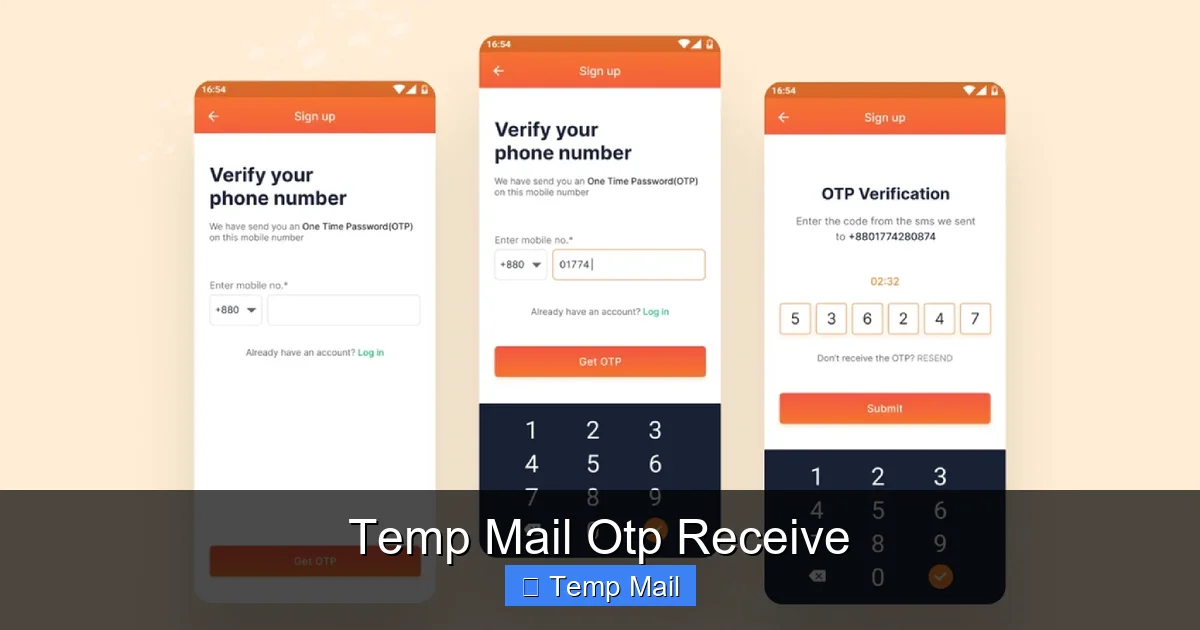
Visual guide about Temp Mail Otp Receive
Image source: s3-alpha.figma.com
Step 1: Generation – Getting Your Disposable Address
You navigate to a reputable temp mail provider website (e.g., Temp-Mail.org, 10MinuteMail.com, Maildrop.cc). The site automatically generates a random email address for you, usually something like xyz12345@tempmail.net. This address is already active, and a public inbox for it is displayed on your screen. No registration, no CAPTCHA (sometimes), no fuss. You simply click a “Copy” button to copy it to your clipboard.
Step 2: Utilization – Using It on the Target Site
You go to the website or app where you need to verify your email (e.g., a forum, a SaaS tool trial, a gaming platform). In the email field, you paste the disposable address. You proceed through the sign-up flow. The site will send a verification email containing your OTP to that temp address.
Step 3: Reception – Finding Your OTP
You switch back to the temp mail website tab. You will see the new email arrive in the public inbox in near real-time. You click on it to open it. Inside the email body, you will find the OTP (the verification code). You copy that code and paste it back into the sign-up form on the target site.
Step 4: Completion and Discard
Once you’ve verified your account, your work is done. You can close the temp mail website tab. You do not need to, and cannot, log back into that address later. After the provider’s set time limit (often 10 minutes to 1 hour, sometimes up to 24 hours), the email address and all its contents are permanently deleted from the server. The address is then recycled and given to a new user. It’s gone.
A
Frequently Asked Questions
What is temp mail OTP receive?
temp mail OTP receive is an important topic with many practical applications.


